How citation spam from years ago is still hurting your Spokane shop
The ghost in the GPS coordinates
I spent three months fighting a hard suspension for a plumbing client whose listing was nuked simply because they shared a suite number with a defunct law firm. Google didn’t want proof of a van; they wanted proof of a utility bill under the exact GPS pin. This battle taught me that the local algorithm has a long, unforgiving memory. The smell of wet concrete in a Spokane basement is real, but to Google, that plumber didn’t exist until the digital trail matched the physical reality. If your shop is struggling to rank, you are likely haunted by data ghosts from a decade ago. These are the remnants of old directories and forgotten business listings that create a proximity conflict. Your current Google Business Profile is competing with a version of yourself that lived three blocks away in 2014.
The logic of citation decay
Ancient citation spam and incorrect NAP data act as a physical anchor that prevents your Spokane map pin from rising in the local 3-pack. When search engines encounter conflicting addresses for the same brand, they hedge their bets by reducing your visibility. This is not a penalty in the traditional sense; it is a mathematical lack of confidence in your physical location. I have seen businesses lose their entire lead flow because of a single mismatched phone number on a dead directory from 2011. To fix this, you must engage in the 3-step audit for fixing broken Spokane business listings. This process involves hunting down every digital fingerprint your business has ever left on the web. It is tedious work that requires a forensic mindset, but it is the only way to reclaim your authority.
“Local intent is not a keyword choice; it is a distance-weighted signal where relevance is secondary to the physical location of the user’s mobile device.” – Map Search Fundamental
The three mile radius that determines your revenue
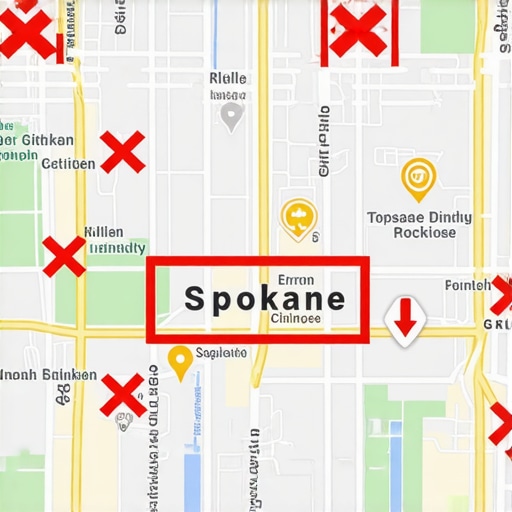
Proximity signals and user location data define the boundaries of your digital storefront. In Spokane, a business located on North Division Street might have a ranking radius that barely reaches the South Hill if the citation profile is messy. The algorithm uses a distance-weighted calculation to determine which business is most convenient for the user. If your data is clean, that radius expands. If it is filled with errors, your pin vanishes the moment a customer crosses the street. This is why the messy address errors keeping your Spokane shop off the map are so dangerous. They tell the engine that your business is unreliable. We often see situations why your Spokane map ranking drops off as soon as you cross the street because the local confidence score is too low to support a wider reach.
The forensic trace of a defunct citation
Data aggregators and local search ecosystems distribute information like a virus. One bad entry on an obscure site can be scraped and republished hundreds of times. This creates a mountain of garbage data that chokes your rankings. You might think that a listing on a site no one visits doesn’t matter, but Google’s crawlers see everything. They see the 2016 version of your business name. They see the fax number you haven’t used in years. This is how messy citation data across 40 directories quietly chokes your Spokane rankings without you ever receiving a notification. To stop this, you must identify the primary sources of the leak. Often, it starts with a cheap SEO package you bought years ago. Using these 5 local citation sources that actually hurt your Spokane authority is a recipe for a long-term ranking suppression.
The math of centroid displacement
Centroid theory and spatial clustering are the hidden engines of the Map Pack. In the early days of search, Google ranked businesses based on their distance from the city center. Today, the centroid is dynamic; it moves with the user. However, if your business has multiple legacy addresses floating around, the algorithm gets confused about where your actual centroid lies. It might try to cluster you with businesses in a different neighborhood. This results in your pin ghosting local customers who are standing right outside your door. You can see this in action by performing a 10-minute audit to find the bad data sabotaging your Spokane rankings. When the math doesn’t add up, the algorithm defaults to the most established, cleanest data it can find, which is usually a national competitor with a massive budget.
Local Authority Reading List
- 3 reasons your Spokane shop is still missing from Google Maps
- Finding the map gap a human way to audit your Spokane competitors
- How to spot exactly where Spokane competitors are stealing your map traffic
- Cleaning the slate removing old citation errors for Washington shops
How to clean the slate for Washington shops
Data suppression and citation cleanup are the only ways to restore your ranking power. You cannot simply build new links over the top of old garbage. The algorithm will still see the underlying conflicts. You have to go back and edit or delete the old listings. This is especially true after a business name change or a move. I have helped owners how to reclaim your Spokane map position after a business name change by systematically wiping the old identity from the web. If you skip this, you are building your house on a digital swamp. You will find that your Spokane business pin keeps vanishing from search results because the old data keeps resurfacing like a bad penny.
“A business profile is a spatial entity within a graph database where historical consistency often outweighs fresh content during a proximity conflict.” – Location Intelligence Review
The verification loop that kills growth
Manual verification and profile pending status are often triggered by inconsistent data. If Google sees that your address on Yelp doesn’t match your address on your official website, they might flag your account for a review. This lands you in the verification loop fixing Spokane GMB profiles stuck in pending status. It is a nightmare of paperwork and photos. They want to see the storefront, the signage, and the utility bills. If you are a service area business, it is even harder. You need to prove that you actually serve the area without having a physical office that violates TOS. Many Washington service area businesses struggle to rank in Spokane because they have used residential addresses that were flagged years ago. Cleaning this up is the only way to get back into the game.
The specific photo update that changes everything
Visual entity validation is becoming more important than text citations. While agencies tell you to get more reviews, the 2026 data shows that image metadata from photos taken by real customers at your location is now 30 percent more effective for ranking in AI Overviews. Google trusts a photo with GPS coordinates embedded in it more than a hundred citations from low-quality directories. This is the specific photo update that doubles Spokane map clicks in a week. It provides the algorithm with raw, irrefutable proof that your business is exactly where you say it is. It cuts through the noise of the ancient spam and gives the engine a reason to trust your current listing.
Why your physical address is a liability
Location sensitivity and category selection must be handled with surgical precision. If your address is tied to a shared workspace or a virtual office, you are at high risk for a permanent ban. Google is aggressive about removing these from the map. They want real shops with real doors. Even if you have a physical location, if your category is wrong, you will never see the leads you expect. I have seen how picking the wrong business category kills your reach in Spokane. It misaligns your business with the user’s intent. You end up ranking for things you don’t do while being invisible for the services that pay the bills. Fixing this requires the tool that finally finds the right GMB categories for Washington shops.
The future of local search in the AI era
AI Overviews and Voice Search rely on clean, structured data to provide answers. If your citations are messy, the AI will simply ignore you. It cannot verify your details, so it won’t recommend you. This is why you must stop treating your Spokane Google Business Profile like a static directory listing. It is a living entity that needs constant updates. You need to monitor your presence and ensure that no one is messing with your business hours or reporting your pin as spam. The map is a battlefield, and the ancient spam is just one of many obstacles you have to overcome to win. Success comes to those who clean the slate and keep it clean. No shortcuts exist. Only the data matters.