
The boring but necessary work of scrubbing Spokane citations
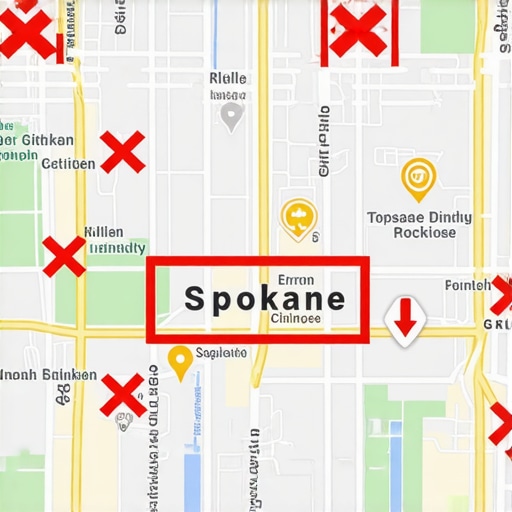
I stood on the corner of Division and Main just after a rainstorm, the smell of wet concrete rising from the asphalt, watching the traffic patterns shift around the city center. To most, it is just a street corner, but to a Map-Spam Investigator, it is a data point in a spatial database where every meter of proximity determines who wins and who dies in the search results. I have spent twenty years hunting the glitches in storefront data, and I can tell you that the difference between a top-three ranking and total invisibility often comes down to the microscopic math of your address strings. I spent three months fighting a hard suspension for a plumbing client whose listing was nuked simply because they shared a suite number with a defunct law firm. Google did not want proof of a van; they wanted proof of a utility bill under the exact GPS pin, a level of forensic evidence that most business owners never prepare for. This experience taught me that the map is not the territory; the map is a volatile, fragile consensus of thousands of local directories that must be scrubbed with surgical precision if you want to stay relevant.
The nightmare of shared suite numbers in Spokane
Spokane Google Business Profile rankings often collapse due to shared office spaces, suite number collisions, and defunct business entities located at the same GPS coordinates. Google’s vicinity algorithm treats multiple businesses in one building as a potential spam cluster, requiring unique utility bills and verified signage for reinstatement.
The pin moved. When that plumbing client lost his listing, his phone stopped ringing before the morning coffee was cold. We found that a law firm had vacated Suite 202 three years prior, yet the local citation sources still tied that specific unit number to a professional services category. When my client moved in, the algorithm saw a plumber at a lawyer’s desk and flagged it as a fraudulent listing. This is why you must understand the reinstatement move for a suspended Washington business profile before you find yourself in a month-long email chain with a support rep in a different time zone. The work of scrubbing these citations is not glamorous. It is the digital equivalent of scraping gum off the sidewalk. You have to find every mention of that old law firm and kill it. You have to ensure that the messy address errors keeping your Spokane shop off the map are scrubbed from the top forty aggregators. One mismatched phone number in a secondary directory can act as a poison pill. It creates a lack of trust in the knowledge graph. If the system sees two different versions of your reality, it will choose the third option, which is to show your competitor instead. I have seen businesses lose 40 percent of their lead flow because of a simple NAP conflict on a forgotten city directory.
“Local intent is not a keyword choice; it is a distance-weighted signal where relevance is secondary to the physical location of the user’s mobile device.” – Map Search Fundamental
Why your physical address is a liability
Physical business addresses in Washington become SEO liabilities when they are associated with virtual offices, UPS stores, or residential zoning. Google prioritizes brick and mortar locations with high proximity salience, often filtering out service area businesses that lack a verified storefront in the Spokane city center.
Proximity is a cruel master. You can have the best website in the world, but if your map pin is on the wrong side of the freeway, you might as well be in another state. This is especially true for contractors. I often explain why most Spokane contractors fail to rank in nearby Washington suburbs, and it usually starts with the physical location of their business centroid. If you are trying to rank in South Hill but your verified address is in Hillyard, you are fighting the laws of physics. The algorithm calculates the distance-weighted signal from the user’s mobile device to your verified coordinates. This is why why your Spokane map ranking drops off as soon as you cross the street. It is a mathematical filter designed to provide the fastest solution to the user. To combat this, you need hyper-local authority. You need to prove you exist in those other neighborhoods through location-specific content and customer check-in data. Without that, you are just a ghost in the machine. I have watched plumbers get buried because their GMB profile was set up at their home address, and Google decided their service area was too broad to be trusted. You have to be specific. You have to be local.
How messy citation data chokes your visibility
Messy citation data involves inconsistent business names, incorrect phone numbers, and outdated addresses across online directories. These data conflicts erode search engine trust, leading to lower map pack positions and reduced organic reach for local Spokane merchants who ignore directory cleanup.
I have seen it a hundred times. A business changes its name from “Spokane Auto Repair” to “Elite Spokane Motors” but forgets to update their Yellow Pages listing from 2012. Google’s crawlers find both. The system gets confused. It wonders if there are two businesses or if one is a duplicate listing. This confusion leads to the algorithm suppressing both. You need a 10-minute audit to find the bad data sabotaging your Spokane rankings before you spend a dime on ads. Most owners think they can just ignore the small directories. They are wrong. Those small sites feed the large data aggregators. If you don’t start cleaning the slate and removing old citation errors, you are building your house on sand. I have used 3 no-nonsense tools to see exactly why Spokane rivals are outranking you, and it almost always comes down to data cleanliness. The proximity beacon of your business needs to be clear and loud. If the signal is garbled by old data, the Map Pack will ignore you. It is a binary world; you are either verified or you are a liability.
Local Authority Reading List
- The broken directory links quietly stealing your Spokane lead flow
- 7 grounded moves to fix a Spokane business listing that wont rank
- The specific citation errors quietly tanking your Spokane map ranking
- Stop using these 5 local citation sources that actually hurt your Spokane authority
- The 3-step audit for fixing broken Spokane business listings
Tools to find gmb categories and keywords
GMB category research tools and local keyword discovery platforms are essential for identifying high-intent search terms in Spokane. Selecting the primary business category correctly can increase search visibility by 40 percent, while secondary categories help capture long-tail local traffic.
Choosing a category is a high-stakes game. If you are a personal injury lawyer but you select “Law Firm” as your primary category, you are competing with everyone from divorce attorneys to patent specialists. You have to find the tool that finally finds the right GMB categories for Washington shops to gain an edge. The data shows that GMB ranking toolkits are no longer optional. They are the only way to see what the competition is doing in the Map Pack. I use the tools that reveal the GMB categories your rivals use to find the gaps in the market. Sometimes the difference between ranking and disappearing is as simple as adding a secondary category like “Trial Attorney” or “Legal Consultant.” But be careful. If you over-optimize or add categories that don’t apply, you will trigger a manual review. I have seen why picking the wrong business category kills your reach in Spokane firsthand. It is a balance between relevance and algorithmic safety. You need finding the specific keywords Spokane customers actually type into their phones at 2 AM when their basement is flooding. That is the data that matters.
“The proximity of the searcher to the business is the single most important factor for local pack rankings.” – Vicinity Update Research
Local seo services to stabilize volatile map rankings
Local SEO services that focus on citation consistency, review management, and technical site health can stabilize volatile map rankings after a Google core update. Ongoing profile optimization and local link building ensure that Spokane businesses maintain 3-pack visibility during algorithmic shifts.
Volatility is the enemy of growth. One day you are the king of the mountain, the next you are on page four. This is why dealing with a sudden Spokane traffic dip after a core update requires a steady hand and a deep dive into your behavioral signals. Google is no longer just looking at your NAP data. It is looking at how people interact with your listing. Are they clicking the call button? Are they asking for driving directions? Are they uploading photos? I have found the specific photo update that doubles Spokane map clicks in a week, and it isn’t about professional photography. It is about authentic, geo-tagged images that prove you are active in the community. If your rankings are jumping around, you might need 7 grounded moves to fix a Spokane business listing that won’t rank. You should also check for broken site redirects. I use a checklist for fixing broken site redirects in Washington because if your website link on your GBP goes to a 404 page, you will be demoted instantly. The map wants to send people to active, functional businesses. If your local landing pages look like AI spam, the system will find someone else. You have to learn how to structure Washington city pages so they rank without looking like AI spam if you want to hold your position long-term.
The ghost in the GPS coordinates
GPS coordinate salience and centroid proximity determine which Spokane business pins appear for near me searches. Google uses location intelligence to filter results based on the user’s physical distance, often hiding businesses that are technically within city limits but outside the hyper-local search radius.
There is a ghost in the coordinates. Sometimes a business does everything right but still can’t rank. We call this map pin ghosting. It usually happens because of data overlaps or service area proxies that are confusing the proximity engine. If you are a contractor, you need to know how to fix map pin ghosting for Spokane contractors without hiring a pro. It involves scrubbing hidden metadata from your site and ensuring your Google Maps embed code is accurate. I have seen why embedding the wrong map code is quietly hurting your local search visibility. It sends a conflicting signal to the crawler. You want the system to be 100 percent certain of where you are. This is also why why service area proxies are killing your Spokane map presence. If you try to use a virtual address to trick the system, the algorithm will find the discrepancy in the LSA verification loop and shut you down. Stick to the truth. Scrub the old data. Build a proximity beacon that cannot be ignored. The local 3-pack is reserved for those who do the boring work of data hygiene. It is not about the newest trick; it is about the cleanest record. I have watched businesses spend thousands on cheap Spokane backlinks only to realize why cheap Spokane backlinks are actually tanking your Washington rankings. They don’t provide local relevance. They provide noise. In the world of local search, noise is a death sentence. You need high-authority, local mentions that tie your NAP to the geography of Spokane. That is how you win. That is how you stay on top of the map while your competitors are still trying to figure out why their pin vanished into the ether.