
The Real Reason Your Shop Only Shows Up for Customers Within a Two-Block Radius
The Real Reason Your Shop Only Shows Up for Customers Within a Two-Block Radius
It is the ultimate frustration for any local business owner. You have spent years building a reputation, you have hundreds of five-star reviews, and your service is objectively better than the competitor three miles away. Yet, when you look at Google Maps, you notice a disturbing trend: your business is essentially invisible the moment someone walks more than two blocks away from your front door.
This phenomenon is known as the “Invisible Wall,” or more technically, the Proximity Filter. In the world of local SEO, we often talk about the “Proximity Paradox.” This is the reality where Google’s obsession with user convenience creates a hyper-local bubble that can stifle the growth of high-quality businesses. You might be the best plumber in Spokane, but if Google decides your “relevance” ends at the neighborhood boundary, your phone stops ringing the moment a potential customer crosses the street.
On Google Support forums, the complaints are endless. Business owners report that they only show up for “very specific terms” or within a “2-3 mile radius,” even in less dense areas. If you feel like your business is being geofenced by an algorithm, you aren’t imagining it. There is a technical reason for this restriction, and more importantly, there are proven ways to break through it.
The Vicinity Update: When Google Shrank Your World
To understand why your ranking radius is so small today, we have to look back at the **December 2021 Vicinity Update**. This was the most significant change to the local search algorithm in over five years, and its primary goal was to “rebalance” the three core pillars of local search: Proximity, Relevance, and Prominence.
Before this update, a business with massive “Prominence” (lots of reviews, strong website authority, and a long history) could often outrank a closer business that was less established. You could be five miles away and still take the top spot from a shop right next door to the searcher. The Vicinity Update changed that. Google tightened the distance requirement, making physical proximity a much heavier ranking signal than it had ever been before.
This update also targeted businesses that were using keyword-stuffed names to manipulate the Map Pack. By devaluing business names that included city names or services (e.g., “Spokane Best Plumbers & Drain Cleaning”), Google forced businesses to rely more on their actual location. The result? A massive “shrinkage” of the ranking radius for millions of businesses. This is often why your Spokane map ranking drops off as soon as you cross the street; the algorithm is now tuned to favor the closest possible solution to the user, regardless of whether that solution is actually the “best.”
The Three Pillars of Local Ranking: Proximity, Relevance, and Prominence
Google officially states that local results are based primarily on three factors. If you want to expand your reach, you must understand how these interact – and which ones you can actually control.
- Proximity: How close is the business to the searcher? This is the one factor you cannot change without moving your office. However, it is also the factor that Google uses as a “filter” to narrow down the initial pool of candidates for the Map Pack.
- Relevance: How well does a local Business Profile match what someone is searching for? This is where google business profile seo comes into play. If your profile is vague, Google won’t risk showing you to someone a mile away because it isn’t sure you offer exactly what they need.
- Prominence: How well-known is the business? This is based on information that Google has about a business from across the web (like links, articles, and directories). Google review count and score factor into local search ranking – more reviews and positive ratings can improve your business’s local ranking.
The secret to breaking the proximity filter is simple to state but difficult to execute: You must maximize Relevance and Prominence so significantly that they override the Proximity bias. When Google is 100% certain you are the best and most relevant answer for a query, it will extend your ranking radius beyond that two-block “dead zone.”
Why Your Radius is Tiny: The “Ghosting” Factors
If you are struggling to rank even a few miles away, it is likely because of “Ghosting” factors – hidden errors that signal to Google that your business is untrustworthy or irrelevant. One of the most common issues is messy NAP (Name, Address, Phone) data. Research shows that inconsistent citation data across the 40+ major business directories (Yelp, YellowPages, Bing, etc.) quietly chokes rankings by creating “entity confusion.” If Google sees three different phone numbers for your shop, it loses confidence in your location data and shrinks your radius to be “safe.”
Another major factor involves the specific map settings that keep your Spokane business from showing up across town. Many business owners incorrectly set their service areas or fail to verify their primary category correctly. For example, why Spokane plumbers lose map rankings to hidden site errors often comes down to technical “schema” markup on their website that contradicts their Google Business Profile (GBP) data.
Furthermore, an incomplete profile is a death sentence for your reach. If you haven’t filled out your “Services” section with granular detail, or if you haven’t posted a single update in six months, Google views your “entity” as stagnant. Stagnant entities don’t get the privilege of city-wide visibility.
Breaking the Radius: Strategies to Rank Further Away
To expand your reach, you need to transition from “having a listing” to “building an entity.” Here is the step-by-step framework for increasing your local map pack seo performance.
1. Advanced Entity Building
Google doesn’t just look at your GBP; it looks at the entire web to see if your business is a “real” entity. Use professional local seo tools to audit your profile and ensure your business is mentioned on high-authority, locally relevant websites. This builds a “moat” of authority that allows you to rank google business profile listings even in competitive neighborhoods. The goal is to make your business the “authoritative choice” for your niche in your city.
2. Leveraging Review Semantics
Reviews are more than just stars; they are data. When a customer leaves a review saying, “The best roofing service in the South Hill neighborhood of Spokane,” they are providing Google with geographical relevance data. Encourage your customers to mention the specific service they received and the neighborhood they are in. This helps the algorithm associate your business with locations beyond your physical storefront. This is a core part of any high-level google maps ranking service strategy.
3. Hyperlocal Content & City Pages
Your website is the “brain” behind your Map Profile. If your website only mentions your main address, Google will keep you in that bubble. You need to create dedicated pages for the different areas you serve. However, you must learn how to structure Washington city pages so they rank without looking like AI spam. These pages should include local landmarks, neighborhood-specific project galleries, and localized testimonials. This signals to Google that your business is physically active in those areas, even if your office is across town.
4. Visual Authority
Don’t underestimate the power of images. We have found that the specific photo update that doubles Spokane map clicks in a week involves uploading geo-tagged photos of your team working at different locations throughout the city. When you upload a photo of a job site five miles away, the metadata (and Google’s image recognition AI) notes that your business is relevant in that specific location.
Tracking Your Progress with Geo-Grids
One of the biggest mistakes business owners make is using a standard rank tracker. If you type “plumber near me” while sitting in your office, you will likely see yourself at #1. But that doesn’t tell you what the customer three miles away sees. Standard rank trackers are useless for local SEO because they only track from a single point.
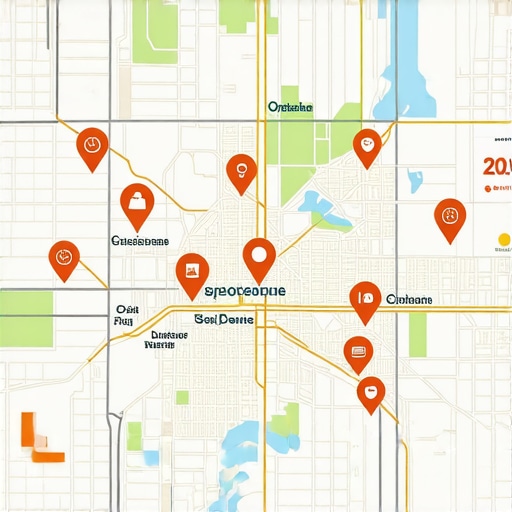
To truly understand your “ranking radius,” you must use geo-grid tracking. Tools like those found at google maps rank tracker allow you to see a map of your city with a grid of ranking points. Each point shows you exactly where you rank in the Map Pack for that specific square block. This allows you to visualize your “bubble” and see it expand as you implement your google business profile optimization tactics. If you see a cluster of “red” (low ranking) in a specific neighborhood, you know exactly where you need to focus your hyperlocal content and citation building.
Without a geo-grid, you are flying blind. You might be making progress, but you won’t know if your radius is expanding from two blocks to two miles unless you can see the grid turn from red to green.
Conclusion: The Path to Local Dominance
The “Vicinity Update” may have made proximity the king of the Map Pack, but it didn’t make it the absolute ruler. By focusing on the “Prominence” and “Relevance” pillars, you can effectively break through the proximity filter and reclaim the visibility your business deserves. Stop settling for a two-block radius. Whether you are looking for local seo services or trying to DIY your growth, the path forward is clear: build your authority, clarify your relevance, and track your progress with the right tools.
The first step is always data. Perform a comprehensive google business profile audit today to find the “ghosting” factors that are holding you back. Once you fix the foundation, you can start pushing your reach across the entire city, ensuring that no matter where your customers are, they find you first.